

Baylor History Major on Study Abroad Tomb Discovery
Baylor Study Abroad programs offer undergraduates a wide variety of educational adventures in locales the world over, but History Major Katie Curley recently had a life-changing experience during her 2025 summer abroad in Italy. Below, Curley shares her remarkable experience.
How did you become a History Major?
“I've had a passion for history ever since the 6th grade, and it has been my favorite subject. Once I reached high school, people started asking me what I was going to major in during college. I knew other people deciding to major in things such as marketing or engineering, but I didn't feel called to any of that. I reflected on my love for history and my love for talking about it. There was truly nothing I loved more than learning about history and being able to teach others to love history just as much as I did. It was then that I realized that I wanted to pursue a PhD in history so that I could teach history at the collegiate level. I felt deep in my heart that this is what I was put on Earth to do, this was my purpose in life. People always told me that I would eventually change my mind, realize that historical research was too difficult. But here I am, seven years later, applying to graduate schools so I can continue my dream. I've always said history was my first love, and I stand by that.”
What is your field of historical interest?
“I am an American Revolution historian through and through. I've known that I've wanted to go into American history ever since I was 14 years old, and here I am as a senior in college. I specifically focus on military history and would like to go to graduate school to become a professor.”
How did you choose to go on Dr. Zori’s study abroad trip to Italy?
“Coming into Baylor, I befriended someone else who went on the trip via marching band, which put the idea of the trip on my radar. I ended up taking the Vikings class with Dr. Davide Zori in the spring of 2025 and fell in love with the class. Dr. Zori would interweave archaeology and history within the class, piquing my interest in material cultures. When he advertised the trip a few weeks into the class, I knew I wanted to go. Before, I was afraid that as a history major, especially with a focus in the United States, I wouldn't know enough to hold my own on this trip. Other than what I had been taught in class, I knew absolutely nothing about archaeology as a discipline. However, I decided to take a leap of faith and give it a shot.”
Can you elaborate on your time in Italy, and particularly the discovery of the Etruscan tomb?
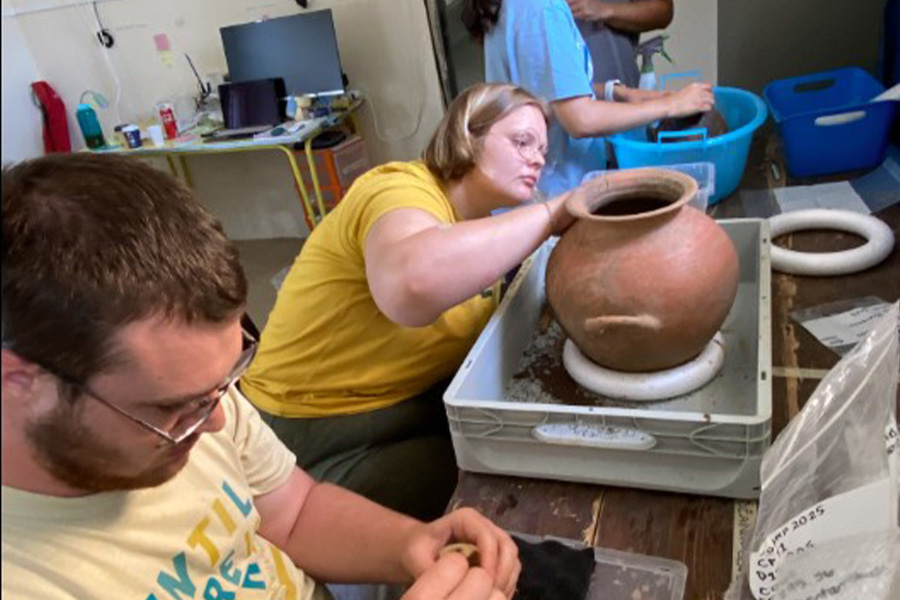
“As someone with a focus on American history, I was initially afraid that I would feel out of my depth on an archaeology trip. However, everyone on the trip was incredibly patient and kind while showing me the ropes. We worked on two main sites: the San Giuliano Plateau, which held a medieval church, and the Caiolo Plateau, which was the home to an Etruscan tomb. The undergraduate students would cycle between the two locations every few days, allowing us all to become familiar with both sites. Every other afternoon, we would spend some time in a lab under the direction of Dr. Jerolyn Morrison, where we would process artifacts.
As a history major, I felt the most connection to the past while in the lab. Maybe it had something to do with the air conditioning, but I appreciated being able to spend longer with individual artifacts. I soon learned how to identify different types of pottery and even piece together broken vessels.
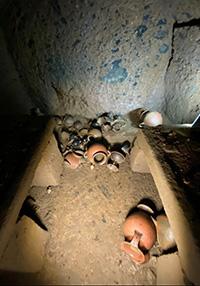
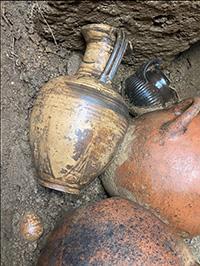
Back at the dig site, we had been digging at the Caiolo site for a few weeks when we found an unusual cut in the rocks. We were already digging the site because of another tomb we had found, but it had been raided long ago. The original raiders left things behind such as Roman coins which was exciting enough for us. But as we continued to dig, we could tell that it was definitely some sort of grave cut. We dug and dug and dug, determined to uncover it before the season ended. We spent weeks digging down and managed to get down about ten feet lower than we had started. Directly in front of the entrance to the tomb was a large rock used to cover the entrance. These types of rocks were used once the burial was complete, and we figured that if the tomb had been raided, they wouldn't have put the rock back. This was when we realized that the tomb may have been previously unopened. Word spread fast that this may be an unopened tomb and the day that we were to open it, it felt like the whole town was there watching. They were able to remove the top portion of the rock and peer inside using a camera. That was when we discovered dozens of nearly perfectly preserved pottery vessels. We were the first people to go into this tomb in over 2,500 years when it was sealed. It was a huge moment. People were hugging and crying. Dr. Jamie Aprile said that this was a once in a lifetime find, and I just happened to be there for the perfect six weeks. From then on it was go-time to completely excavate it before we left Italy. We are the only people that dig at the site, and we only come once a year, so we didn't want to leave anything behind for a year while we were away.
One anecdote I feel is important to mention is the bodies. Whenever I tell people we found a tomb they always ask about the bodies. After 2,500 years, there wasn't much of a body left, as they were practically just dust. I believe they said that there were likely four people who had been buried there, or that 4 was the minimum number of individuals (MNI, as the anthropology majors proudly proclaimed.)”
Would you recommend other history majors (or students generally) to take study abroad trips?
“I would absolutely recommend studying abroad to just about anyone. The trip was all I would talk about once I got back to the United States. Italy is a beautiful country with the most amazing culture and people. But even as someone who doesn't specialize in Italian history, it was still a wonderful experience. Getting to work directly with material cultures and getting to interpret them will help me in the long run. In the past I relied almost exclusively on primary documents for historical research, but this has vastly broadened my horizons as to what I can use for research. This trip was truly life changing and I'm so glad I went.”