

Department of History Presents the 2026 Black History Month Lecture ft. Dr. Nana Osei-Opare | "Socialist De-Colony"
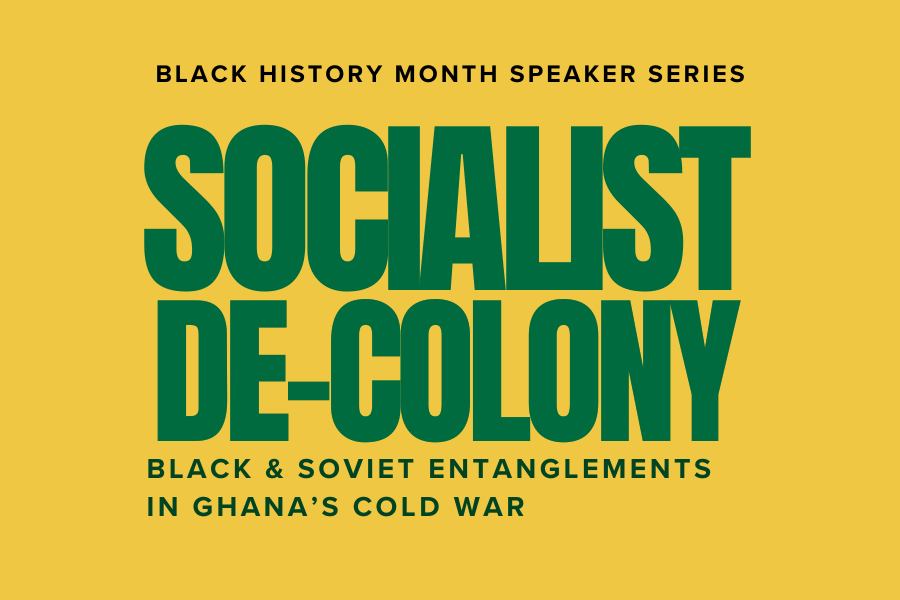
The Department of History presents this free and open to the public lecture for our 2026 Black History Month Speaker Series, which features Dr. Nana Osei-Opare, Assistant Professor of History at Rice University.
The lecture will be held on February 12th, 2025 at Moody Memorial Library in the Schumacher Flex Commons. The lecture will be held from 3:00 - 4:30 pm.
Dr. Nana Osei-Opare is an Assistant Professor of History at Rice University. He coedited Socialism, Internationalism, and Development in the Third World with Su Lin Lewis (Bloomsburg, 2024). He has published articles in Comparative Studies in Society and History, the Journal of African History, and the Journal of West African History. He was a National Endowment for the Humanities and Ford Foundation Fellow at the Schomburg Center for Research in Black Culture (2023-2024) and an Andrew Mellon Fellow for Assistant Professors at the Institute for Advanced Studies, Princeton (2022-2023). Osei-Opare is currently co-editing the two-volume Cambridge History of African Political Thought and a special issue on Black life and Blackness in Slavic, Eastern European, and Eurasian societies for the Slavic Review (forthcoming Fall 2025). Osei-Opare's public writings have appeared in the Washington Post, Slate Magazine, and Foreign Policy Magazine.
Socialist De-Colony: Black and Soviet Entanglements in Ghana's Cold War
Thursday, February 12th, 2026 | 3:00 - 4:30 pm | Schumacher Flex Commons - Moody Memorial Library
Led by the charismatic Kwame Nkrumah, Ghana won its political independence from the United Kingdom in 1957. It precipitated both the dying spiral of colonialism across the African continent and the world’s first black socialist state. Utilizing materials from Ghanaian, Russian, English, and American archives, Nana Osei-Opare offers a provocative and new reading of this defining moment in world history through the eyes of workers, writers, students, technical experts, ministers, and diplomats. Osei-Opare shows how race and Ghana–Soviet spaces influenced, enabled, and disrupted Ghana’s transformational socialist, Cold War, and decolonization projects to achieve black freedom.