

Dr. Maggie Elmore Awarded Louisville Grant for Researchers
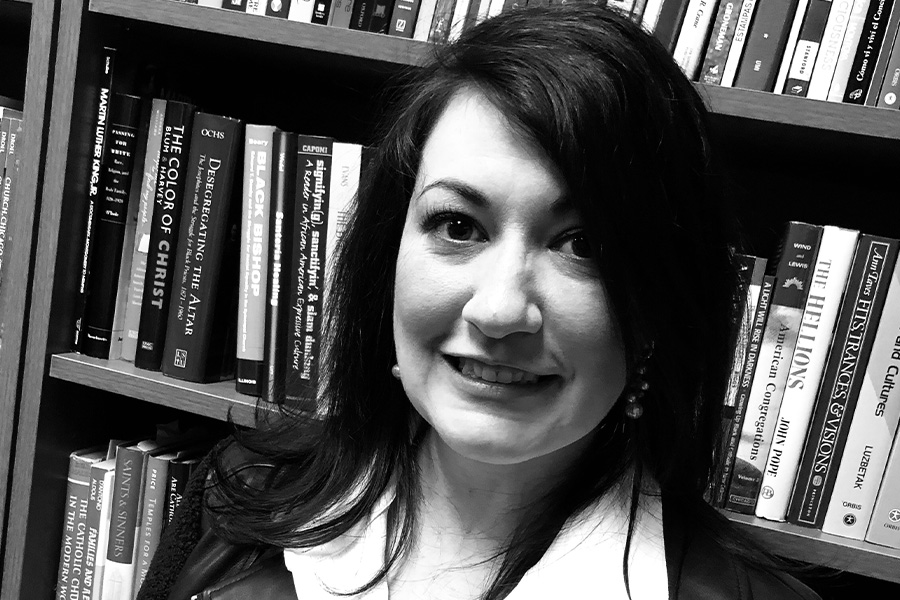
Dr. Maggie Elmore, Associate Professor of History, was recently awarded the prestigious Louisville Grant for Researchers, enabling her to spend the ’25-’26 academic school year finishing her book, Unholy Border: Catholics, Migrants, and the Making of the US-Mexico. Below, Dr. Elmore expounds on her role as a historian of the borderlands, her new book, and how the Louisville Grant is aiding her work.
What does it mean to be a historian of the borderlands?
That’s such a great question! On the one hand, I literally study how borders are made and change over time, and how people experience life either crossing the border or living in regions divided by borders. I think the thing that jumps immediately to most people’s minds is the US-Mexico border. That makes sense because we hear a lot about the border in the media, on social media, etc. But, the idea of borders doesn’t just apply to the border between the United States and Mexico, right? Borders can be geopolitical, but they can also be ideological, religious, or political. So it also means studying the things or categories that divide people – that can be faith, political affiliation, citizenship status, class, language, just about anything. I study how these categories are made and enforced, but also how individual people and communities give them meaning.
What drew you to specialize in this field?
I like to tell people that I study the things most of us were told not to talk about at the dinner table: religion, politics, race, and money. I’m also just a really curious person. So, one of the first questions I had as a freshman in college was “why aren’t we supposed to talk about these things?” Followed by, “but what would happen if we did talk about them?” As you can imagine, this opened several cans of worms, but what I found is that most of us need a way to talk about the difficult topics which we might hold strong and differing opinions about. As a historian, I want to know how people handled these issues in the past – has how we navigate tough issues changed over time? (Yes). On a more personal note, my family is the product of migration across the Americas – my father was born in Brazil to an American father and Brazilian mother and my husband is from central Mexico. I grew up talking with my tías who lived in Brazil and hearing my American grandmother’s stories of her family’s migration into Texas in the mid-1800s. My in-laws live in Mexico. The idea of movement and borders is foundational to my own identity. I’m also from a family with a mixed religious identity (more borders!) – half of my family is Protestant and the other half is Catholic. Another way to think about it is that I’m interested in the things that keep people apart as well as what draws them together.
Please tell us about the book you are writing.
Unholy Border: Catholics, Migrants, and the Making of the US-Mexico Border is based in the 20th century US-Mexico borderlands and explores the role of faith-based immigration agencies in creating both gateways and barriers for migrants entering the United States. It’s both a legal and political history of the borderlands and US immigration policy. I cover nearly a century, and show how, starting in the 1920s, migrants challenged Catholic and government officials to create more humane border crossing policies, while prominent Catholic leaders used their ever-expanding political influence to make and enforce US immigration and border policies. I trace the experiences of migrants – many of whom were US citizens – and their families as they moved between the United States and Mexico.
So, the people who are at the heart of my book experienced national borders in a real way, but they also experienced conceptual and legal borders based on race and citizenship status. One of the things that surprises a lot of people is how fluid US citizenship has historically been. It’s never been easy to obtain US citizenship, but the ways that people have lost citizenship are staggering. For example, for part of the 20th century, American women who married men who were not eligible for US citizenship (and this was a pretty broad category of people prior to 1965) automatically forfeited their US citizenship. But, immigration officers weren’t always clear on who was or who wasn’t eligible for citizenship, and several of the families in my book were illegally denaturalized despite being third or fourth generation US citizens. Faith-based immigration agencies in the borderlands, especially those affiliated with the Catholic Church, worked hard to keep families together and to help mixed status families (families that had family members with different immigration or citizenship statuses) navigate US immigration policies. As you can imagine, conversations about immigration and politics were as complicated in the 1950s as they are today. One thing that was really crucial to creating workable and humane border policies was the willingness of people to engage in what I call “the quiet work.” The quiet work involved reaching across the political aisle – or across ideological borders if you will – to work together to create policies and practices that prioritized things like family unity and treating migrants with dignity. The social workers, faith leaders, and politicians who did this quiet work didn’t do it for the glory – in fact the public often didn’t know they were doing it – they did it because they believed it was the right thing to do.
How is the Louisville Institute’s Grant for Researchers aiding your research and writing?
The generous support from the Louisville Institute, the College of Arts & Sciences, and the History Department has allowed me to dedicate an entire year to bringing Unholy Border to completion and to writing an article about how immigrants have navigated the US legal system to defend their civil rights. It’s also let me kick start a second book project that will take up this idea of “quiet work” and focus on the political impact of sensationalized human trafficking cases. Not merely a recounting of an unsavory past, An Illicit Trade: The Afterlives of Human Trafficking in 20th Century America will show how policymakers, faith leaders, community organizers, and survivors quietly came together across the political aisle. Together, they worked to depoliticize perennial questions related to human trafficking and provide resources for the individuals and communities whose lives are impacted by trafficking.