

History Alumnus Sam Klatt Makes His Mark in Documentary Film
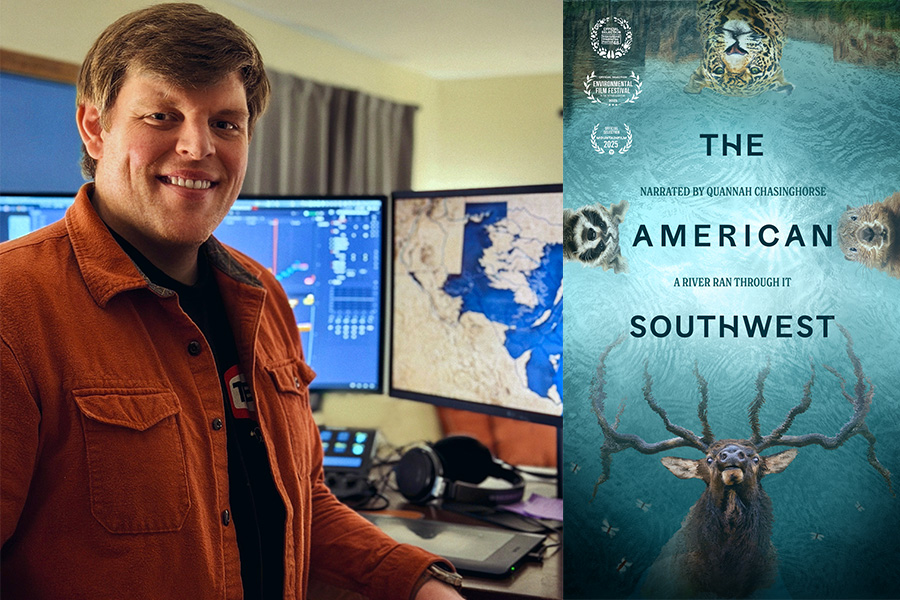
Sam Klatt, Baylor Film and Digital Media Major and History Minor (2012), recently debuted the documentary film, The American Southwest, at the Mayborn Museum. Below, Klatt reflects on his time at Baylor and the path that led him to become a documentary film producer and editor.
How did you choose History and Film and Digital Media for your studies when you were a Baylor student?
I have to credit my father for my path; he is a massive history buff and a lifelong devotee of the arts. From a young age, he instilled in me a deep respect for history and world affairs. Simultaneously, we grew up watching movies as a family—not just the classics, but many off-beat art house, independent, and documentary films, which fostered a general artistic curiosity in me.
I attended a high school with strong humanities and fine arts programs, and seeing those interests intersect felt so natural that I fell in love with that corner of academia (likely to the lasting disappointment of my high school math and science teachers).
When I was deciding on a college, my dad set up a tour of the Baylor Film Department with Chris Hansen and arranged for me to sit in on a history lecture with Dr. Barry Hankins. Pretty quickly, the plan fell into place. I did feel a certain amount of self-imposed pressure to pursue a more 'traditional' path, and I was genuinely nervous about leaning into a career as unconventional as film—even though that’s where my heart was. It was my dad who really encouraged me to ignore those nerves and take that leap of faith.
Do you feel that minoring in History has informed your work as a filmmaker and storyteller?
The path through the film industry can be a bit meandering. I started in commercial production, always knowing that I ultimately wanted to pursue feature films and documentaries. Documentary work inherently has a historical bent, even when the subject matter isn’t strictly ‘academic.’ Because of that, my history studies have absolutely informed my work as an editor and storyteller, but it did take a few years to get to a place where I was really re-engaging with my passion for history.
The first feature I worked on as the post-production supervisor and assistant editor was Dear Mr. Brody (2021), directed by Keith Maitland—a filmmaker I greatly admire. The film explores the ‘stranger than fiction’ fallout from young Michael Brody’s 1970 announcement that he would distribute his massive inheritance to anyone in need. For that project, having a grounded understanding of the social and political climate of 1970 was core to the story, and I believe it enriched the perspective I was able to provide as our team worked on the film. Much of my role involved diving into the archival research, and it was incredibly rewarding to see those research habits from my history courses finally bridge the gap into my professional skillset.
More recently, I’ve had the great privilege of editing and producing several natural history films for director Ben Masters. One lesson that still rings in my ears is from my first history course at Baylor with Dr. Julie deGraffenried. She introduced us to Barbara Tuchman’s The Proud Tower and the "starting point paradox," "The historian’s problem is where to begin... History has no beginnings, only continuities." Evaluating those moments—not only how we decide when to begin our films, but also the idea that what we leave out is often as important as what we leave in—is the core tension of working as an editor.
How did you get involved in editing and producing The American Southwest, and can you elaborate on what inspired the making of this documentary?
Ben Masters and I have made several films together (including a new one due out this fall). We have a wonderful creative partnership; he is incredibly proficient at galvanizing a team to realize a vision and getting these movies made. As we were finishing our 2022 film Deep in the Heart, a natural history film about Texas, we were approached to make a film about the state of wildlife throughout the broader Southwest.
Our first challenge was defining what the Southwest actually is, as there isn’t one standardized definition. We eventually settled on a geographical anchor: ‘anything that falls within the Colorado River Basin.’
From there, we realized that water management would be the connective tissue of the entire film.
While we had a mandate to showcase the various ecoregions of the Southwest, we knew we had to grapple with the history of the region. This allowed us to select stories that highlighted unbelievable landscapes while also wrestling with the difficult histories of Indigenous peoples, European settlement, and the current health of the land itself.
You recently had the opportunity to screen The American Southwest at the Mayborn Museum here in Waco, Texas. How was your experience showing your film to the Waco and Baylor communities?
Goodness, showing the film at the Mayborn was such a fun full-circle moment. I love Waco. My dad actually grew up there, so I spent a lot of time visiting my grandparents in town as a kid. Then, winding up at Baylor and having such a profound and enriching academic experience, meeting my wife, and making lifelong friends...getting to come back to a place I once called home was easily one of the highlights of my career.
What are you hoping audiences will take away from The American Southwest?
First and foremost, I hope audiences fall in love with what is truly one of the most iconic landscapes on Earth. My hope is that from that love and pride, a desire will flow to be the absolute best stewards of this land we can be. That means celebrating our successes—the rivers, the wildlife, and the vistas—while also recognizing the ramifications of our impact on the natural world.
In the film, we use the benefit of hindsight to look at what now may seem like mistakes, but at the time were often simply decisions made by people trying to do their best with the information they had. Rather than explicitly preaching our own viewpoints, we want to invite the viewer to the table to form their own perspective. Hopefully, that leads to engagement with some of the incredible conservation organizations we worked with during production.
Indirectly, I hope a takeaway from any film is that it truly takes a village. This was a massive, multi-year effort, and I’m so grateful to our post-supervisor and assistant editor Chet Stefan, assistant editor Falcon Keller (my right-hand folks), and our producers Ryan Olinger, Katy Baldock, and Dr. Len Necefer. As always, I am grateful to my friend, Ben Masters, and lastly (but certainly not least), our narrator, Quannah Chasinghorse, who trusted us to tell this story well, which meant ensuring Native voices were central to our process.
Are you working on any other projects you would like to share?
Our team is currently hard at work on a follow-up to Deep in the Heart. It’s a new film that celebrates our Texas rivers, and it’s due out this coming fall!