

A Year in Senegal with Boren Award Winner Rebeca Blemur
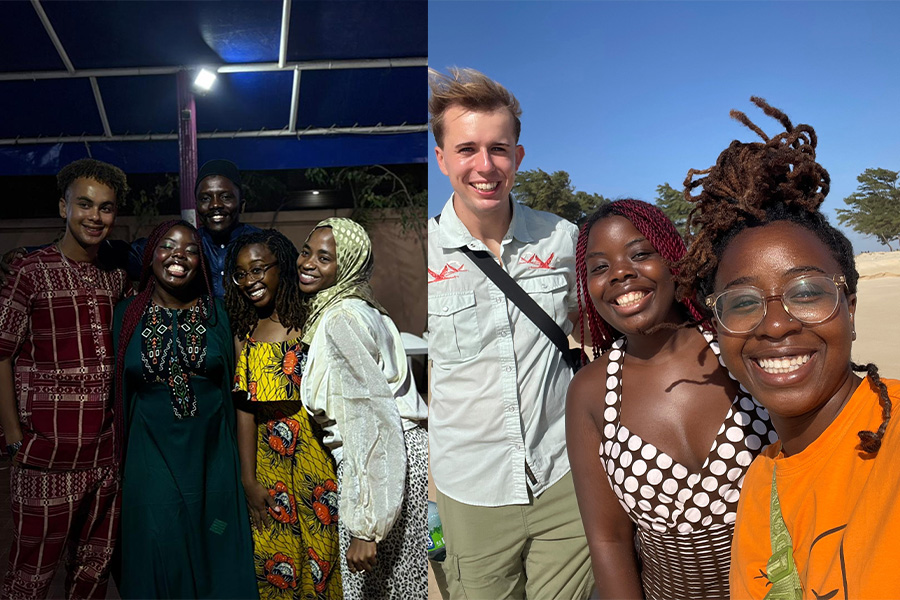
History Ph.D. student, Guittard Fellow, and Boren Award winner, Rebeca J. Blemur, recently returned from a year abroad in Senegal where she studied at the West African Research Center (WARC) in Dakar. Blemur’s research examines the intersection of migration, race, and labor in the Atlantic World and her current research examines the experiences of Haitian taxi drivers during the Duvalier dictatorships through a transnational and inter-American framework. Her work traces the interconnected histories of Haitian drivers in Boston, Massachusetts, and Montreal, Quebec, exploring how migration and mobility shaped their experiences across national borders.
Below, Blemur reflects on her year abroad and how it has shaped her academic pursuits.
I received the 2025 Boren Fellowship as part of my ongoing pursuit of French language acquisition. As a historian of Haiti and the Haitian diaspora, I came to understand the importance of improving my French not only to engage more deeply with primary sources, but also to communicate with the communities connected to my research and with leading scholars in my field.
The previous summer, I received an award that allowed me to participate in the Baylor in Paris program, which became my first immersive French-language experience since beginning my studies at Baylor. After returning, I continued to invest in my language development by working with a private tutor, creating independent studies, and using research papers and other course assignments as opportunities to engage with French-language sources.
Receiving the Boren Fellowship affirmed that the work I had put into language acquisition was not in vain. More importantly, it gave me the opportunity and resources to fully immerse myself in French language study in a Francophone environment. The award enabled me to spend a year in Senegal developing my language skills while also expanding my intellectual and cultural understanding of the Francophone world.
I am incredibly grateful to my department, my colleagues, and Baylor's Office of Engaged Learning for their encouragement and assistance throughout the application process. Their support played an important role in the success of my application.
My year in Dakar, Senegal, was nothing short of amazing. While there, I studied at the West African Research Center (WARC), where I took four French-based courses: French Language and Conversation, Senegalese History and Politics, Francophone Literature, and Survival Wolof. Because my courses were taught entirely in French, I experienced a level of linguistic immersion that challenged me to use and strengthen my French every day. My Senegalese professors, several of whom have served as faculty members at Université Cheikh Anta Diop (UCAD) for many years, also brought extensive experience working with Anglophone students into the classroom.
In addition to my coursework, I had the opportunity to live with a host family, which allowed me to practice the language skills I was developing in the classroom in everyday settings. Outside of classes and time with my host family, I traveled throughout Senegal, visiting places such as Gorée Island, Toubacouta, and Saint-Louis, as well as the neighboring country of The Gambia. Through these experiences, I formed lasting friendships and relationships with mentors who have influenced the ways I think about my research and the possibility of incorporating African history, particularly Senegalese history, into my future teaching and scholarship.
These interests were further solidified through my research fellowship with the History Department at Université Cheikh Anta Diop. Through the fellowship, I attended lectures and assisted my supervising faculty member with research. I quickly learned that universities abroad can operate very differently from those in the United States, not only in terms of scheduling and administrative functions, but also in how professors structure their classrooms and approach teaching.
One of the most impactful lessons I took from observing these classes was the importance of language in teaching. The seminars I attended were conducted primarily in French, but instructors would sometimes incorporate Wolof to ensure that students understood the major points and themes of a lecture. As someone interested in teaching in Francophone countries and prioritizing French-language sources in my research, observing this firsthand was especially meaningful. My year in Senegal ultimately strengthened my language abilities while broadening the geographical and intellectual scope of how I understand my work as a historian.
Now that I have returned to Baylor, my immediate goal is to complete my comprehensive exams and defend my dissertation prospectus, allowing me to transition to ABD [all-but-dissertation] status. At the same time, I am applying for grants and fellowships that will support the next stage of my dissertation research and provide the necessary funding to conduct archival and field research.
As I move forward, I also plan to build upon the language skills, relationships, and perspectives I developed during my year in Senegal. My experience abroad has encouraged me to think more intentionally about how the broader Francophone world can inform both my dissertation and my future teaching. I am excited to bring these experiences back to Baylor as I enter the next phase of my doctoral studies.